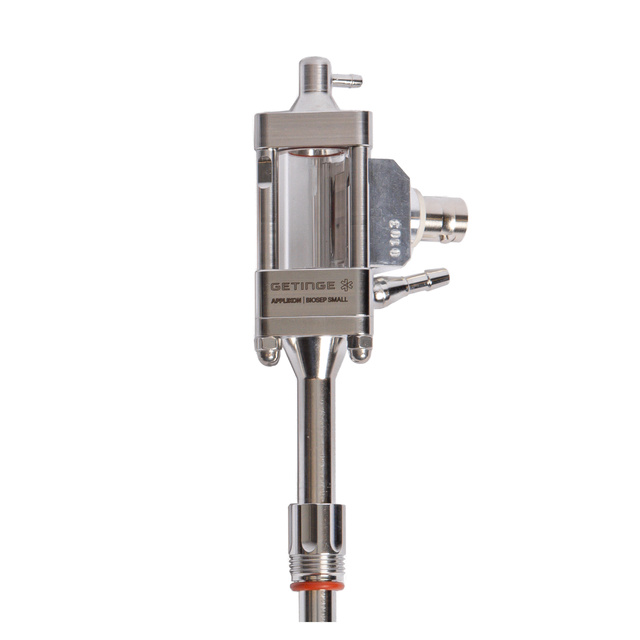
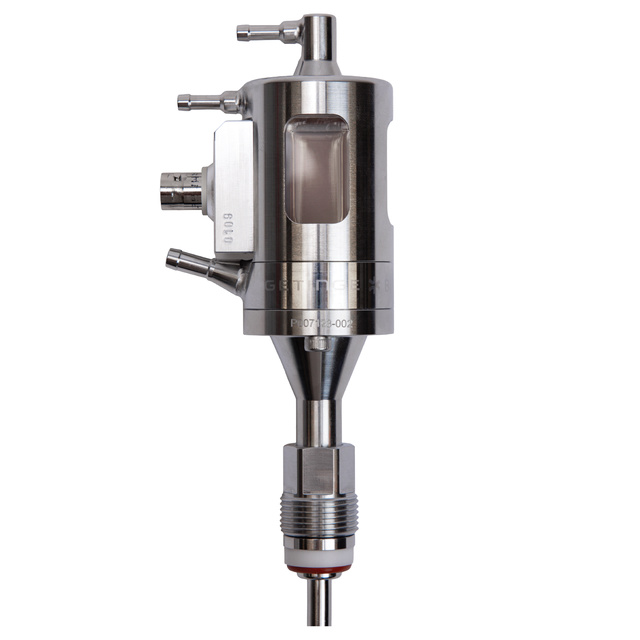
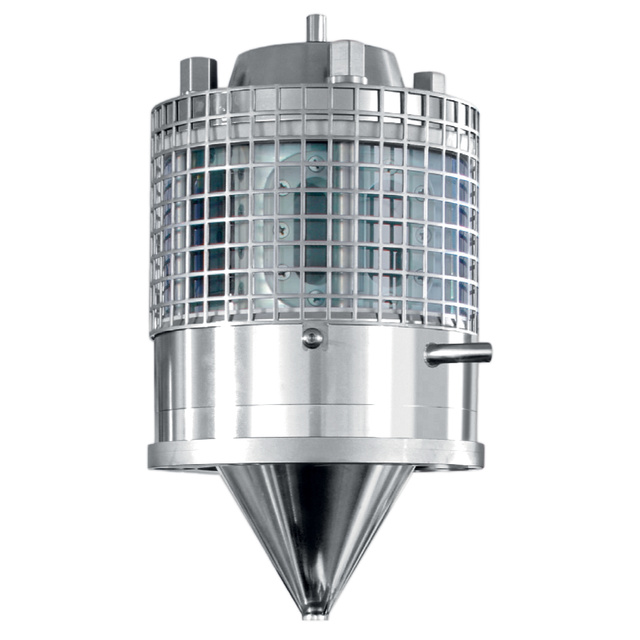
The ideal solution for long-term perfusion operation
- Automatic removal of cell debris
- No damage to the cells
- No fouling or blocking allows for long term operation
- Scalable perfusion device (0.1 – 200 L / day)
Typical configuration of acoustic cell retention system
Typical configuration of acoustic cell retention system
A BioSep controller automatically generates the acoustic field within the resonator chamber.
A resonator chamber, where cell separation occurs, is compact and easy to install on the bioreactor head plate.
A harvest pump determines the perfusion rate in the resonator chamber.
A recirculation pump infuses cell suspensions into the chamber.
A feed pump functions as an actuator of the level control loop to keep the medium level in the reactor at a constant level.
Compressed air cools the transducer to prevent the resonator’s overheating and maintain the separation efficiency.
Inside the chamber
Inside the chamber
Cell suspensions from the bioreactor are pumped into the resonator chamber mounted on the bioreactor head plate.
The standing acoustic waves force suspension cells into planes, where they form loose aggregates.
The clarified harvest flow passes through the acoustic field.
The concentrated cells are returned to the bioreactor.
Aggregate formulation
The flow inside the resonator chamber is split between the harvest flow and the return flow, with the harvest pump determining the flow rate through the resonator.
The settling process is enhanced by periodically stopping the acoustic field and the harvest pump.
Watch the video to see how the clarified harvest flow passes through the acoustic field, while the concentrated cells are returned to the bioreactor.
High separation efficiency
Using the technology of acoustic resonance allows for high separation efficiency (99%) without damaging any cells. One standard mode of operation employs, for example, a harvest pump at the exit port of the resonator chamber, and a recirculation pump for the return of separated cells that settled from the acoustic energy field within the resonator chamber. Alternatively, the Applikon BioSep system can be set up to allow for semicontinuous operation or alternative strategies of cell recirculation.
Easy to install and operate
The Applikon BioSep can be mounted directly onto the bioreactor head plate. An extensive characterization has proven full scalability between the different sizes allowing you to start in perfusion mode directly at the beginning of your process optimization all the way through to production.
The Applikon BioSep system is available in 1 L/day, 10 L/day, 50 L/day, and 200 L/day and is compatible with any brand of bioreactor.
Proven under cGMP conditions
The Applikon BioSep system is used as perfusion device in various commercially operated cGMP processes. The 50 L/day and 200 L/day separation model are by default supplied with all documentation and services required for cGMP operation.
Specifications
| BioSep system | Small | Medium | Large | Production |
| Nominal perfusion rate | 1 L/day | 10 L/day | 50 L/day | 200 L/day |
| Minimum perfusion rate | 0.1 L/day | 0.7 L/day | 5 L/day | 20 L/day |
| Separation efficiency | Up to 99% (depending on cell concentration and perfusion flow) | |||
| Minimum cell concentration | 2 x 10⁵ cells/ml (depending on cell size) | |||
| Bioreactor connection | 8 mm OD tube | 12 mm OD tube | Mounted separately | Mounted separately |
| Clarified medium outlet | 3 mm hosebarb | 6 mm hosebarb | 10 mm hosebarb | 0.5” TC |
| Recirculation line inlet | 4,5 mm hosebarb | 6 mm OD diptube | 0.5” TC | 0.5” TC |
| Weight | 0.2 kg | 0.5 kg | 1.5 kg | 13 kg |
| Cuvette volume | 3 mL | 7 mL | 50 mL | 290 mL |
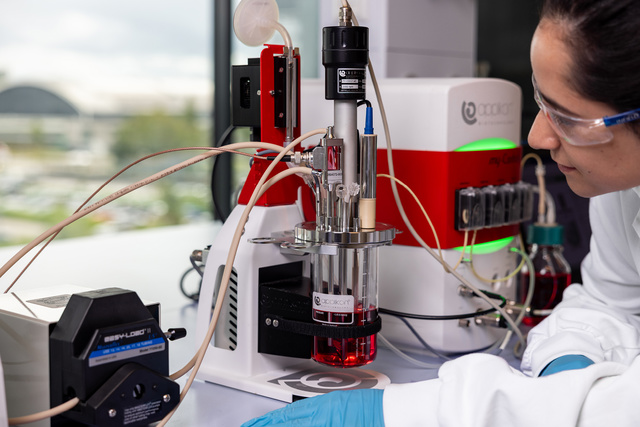
The Applikon BioSep is ideal the for following applications:
- Perfusion cultures
- Cell therapy applications
- Concentration of cell / particles
- Process development studies
- Washing
- First step in downstream processing
-
Learn more about how to optimize your bioprocess by continuous perfusion