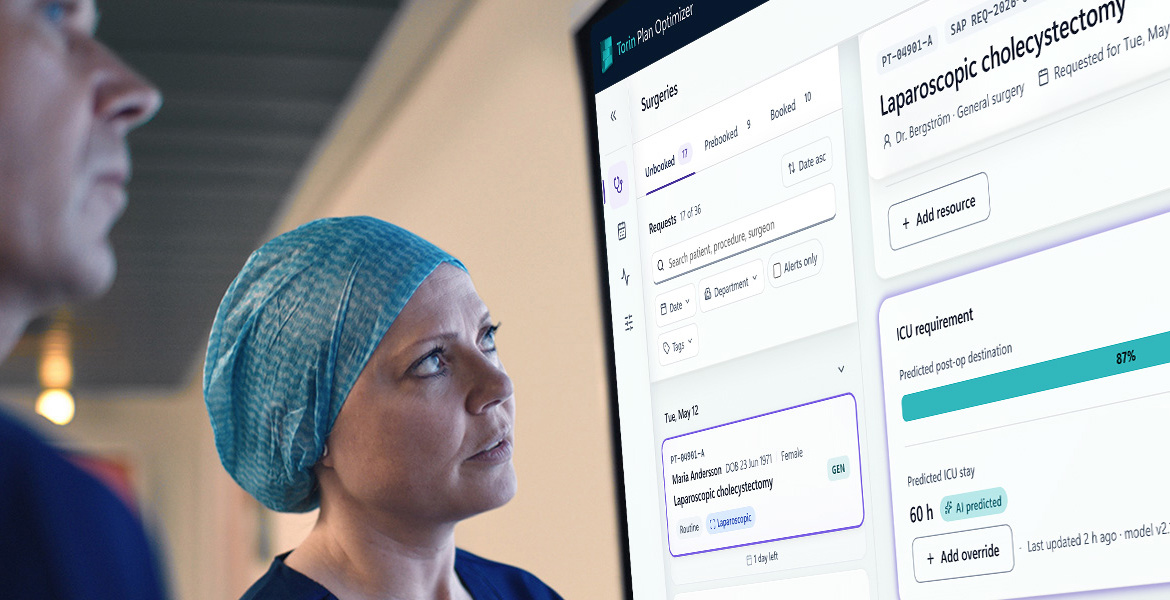
Surgical planning doesn't stop at the OR door. ICU and post-operative bed availability can have a direct impact on surgical schedules, yet these downstream capacity needs are often not considered early enough. New research shows how AI can help predict ICU needs before surgery, giving hospitals an opportunity to plan ahead and reduce potential disruptions.
Key findings on ICU capacity in surgical planning
Why ICU capacity is the overlooked variable in surgical scheduling?
Surgical planning today is built around theatre availability, staff rosters, equipment, and estimated case duration. These are the variables that shape the day. Post-operative destination, whether a patient will need an ICU bed, an IMC bed, or a standard ward, is typically not one of them. It is resolved during or after the procedure, well downstream of the booking decision.
That gap has consequences. When a patient unexpectedly requires critical care after surgery, the disruption does not stay at the ICU door. It runs back into the surgical schedule: PACU backs up, the next case loses its recovery bed, elective lists shift, and the team that planned to finish at 17:00 is still there at 19:00[1]. Reported rates of unplanned ICU admission after non-cardiac surgery range from 0.12% to 6.7%, with the UCSF study recording 2.3%[1]. The frequency is low, but each event carries costs well above its planned equivalent[1], and the ripple effects extend across the entire surgical day. Recent hospital data underlines the scale of the operational impact: in a 2025 study of same-day elective surgery cancellations at a large university hospital, unavailable ICU beds accounted for 21.7% of cancellations, second only to unavailable OR time (24.0%)[2].
The pattern is consistent: the information that could prevent this disruption exists within the hospital’s own data[1]. It is simply not yet part of the booking flow where it would make a difference. The question is whether surgical planning tools can be extended to include it, and recent research suggests they can[1].
What current scheduling tools miss about downstream capacity?
Today’s surgical scheduling systems optimise for theatre utilisation, staffing, and case duration. Downstream destination, whether a patient will need an ICU bed, an IMC bed, or a ward bed, is not part of that equation. The reason is complexity. The factors that influence post-operative destination, patient physiology, procedure type, surgeon factors, comorbidity interactions, real-time bed census, number in the dozens. They interact in patterns that only become visible when thousands of prior cases are analysed together[1]. Current planning tools were not designed to process that kind of input.
Could post-operative destination be assessed earlier in the workflow, at booking or pre-assessment, so it feeds into the surgical plan before the day is locked? In principle, yes. But not at the resolution that makes it actionable. A specialty-wide average might indicate that roughly one in forty patients will need ICU after a given procedure type[1]. It does not indicate which patient, on which day, will be the one. That patient-specific resolution is what machine learning now makes possible, and it does so using data the hospital already captures at the point of scheduling[1].
A specialty-wide average might indicate that roughly 1 in 40 patients will need ICU after a given procedure type[1]. It does not indicate which patient, on which day, will be the one. That patient-specific resolution is what machine learning now makes possible, and it does so using data the hospital already captures at the point of scheduling[1].
How machine learning predicts unplanned ICU admission before surgery?
A 2025 study from the University of California San Francisco (UCSF), conducted at the Bakar Computational Health Sciences Institute and published in BMC Anesthesiology, tested whether machine learning could predict unplanned ICU admission using only information available before surgery[1]. The researchers built and validated a model drawing on preoperative patient characteristics, procedure data, and comorbidity profiles from 4,658 surgical patients[1]. No intraoperative inputs were used; the prediction requires nothing from the procedure itself[1].
When comparing a patient who went on to need unplanned ICU care with one who did not, the model assigned the higher risk to the right patient 8 out of 10 times[1], demonstrating the model's ability to distinguish between patients with different levels of risk. In plain terms, it can flag the patients most likely to need unplanned ICU care, using only variables available at scheduling. Just as importantly, that prediction is available days before the patient reaches the theatre[1]. It provides a graded, patient-specific probability, not a broad risk category based on specialty averages, and not an alert that fires when the surgical day is already committed[1].
This matters because of when it lands in the workflow. At the point of booking, the surgical plan is still open. Downstream capacity can be factored in alongside theatre slots, staffing, and case duration, the same variables the schedule already manages. Conflicts between surgical volume and bed availability surface when rearranging the day is still a planning conversation, not a last-minute escalation[1]. For hospitals already running structured pre-assessment workflows, the integration is natural: the model draws on the same data that pre-assessment captures and returns its signal at the same moment the scheduling decision is being made.
Building ICU capacity into the surgical booking flow
A prediction is only as useful as the decision it reaches. For post-operative destination to become a real input to the surgical plan, the scheduling process needs to account for ICU, IMC, and ward capacity alongside OR slots, not as a separate, downstream concern, but as part of how the day is assembled[2]. When a case with elevated ICU probability is booked on a day where critical-care beds are already committed, that conflict needs to be visible in the schedule itself, before it plays out on the ward[2].
For the planning team, this changes what prebooking looks like in daily practice. Instead of scheduling against specialty averages and hoping downstream capacity will hold, the case manager sees the specific probability alongside the day’s projected ICU census[1]. Escalations become genuine escalations, not the daily norm. For patient flow, the PACU stops functioning as an unofficial ICU waiting room when the schedule anticipates critical-care needs at booking rather than discovering them at recovery[1]. And by anticipating critical-care needs earlier, hospitals may be better positioned to avoid last-minute disruptions, including some of the same-day cancellations linked to unavailable ICU beds, which accounted for 21.7% of cancellations in the study[2].
Accounting for downstream capacity alongside theatre resources could support more informed surgical planning, rather than treating bed availability as something to resolve after the list is set. The prediction model supplies the signal. The scheduling logic makes the conflict visible. The case manager makes the call[1]. The principle throughout is that the system brings a previously missing variable into the planning flow, and leaves the decision with the people responsible for the schedule.
The prediction model supplies the signal[1]. The scheduling logic makes the conflict visible[2]. The case manager makes the call[1]. The principle throughout is that the system brings a previously missing variable into the planning flow, and leaves the decision with the people responsible for the schedule[1].
How anticipatory ICU planning changes daily surgical operations
No model will eliminate unplanned ICU admissions. Clinical unpredictability is part of the environment. But there is a meaningful difference between a surgical plan that discovers a downstream capacity conflict on the day and one that anticipated it at the point of booking². The first demands reactive problem-solving under time pressure. The second allows considered planning with options still on the table.
This research opens up new opportunities to consider downstream capacity needs earlier in surgical planning[1]. These findings suggest opportunities to bring this information into the surgical booking flow.
For perioperative and hospital leadership, the question is straightforward: should downstream destination remain an afterthought in surgical planning? Or should it take its place alongside theatre capacity, staffing, and case duration as one of the core variables shaping the surgical day?
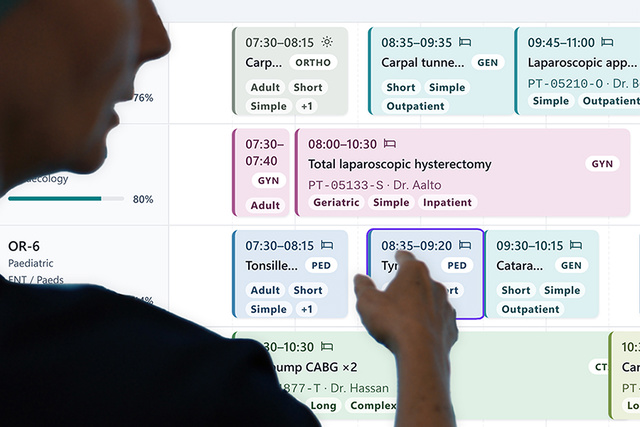
Torin Plan Optimizer
Anticipating needs to keep surgical care on track
Balance complex surgical workflows with greater clarity and control, even when resources are constrained. Torin Plan Optimizer uses AI to predict surgical duration and post-operative needs, aligning OR schedules with surgeon and staff availability, room capacity, and ICU and ward resources.
AI proposes. You decide.