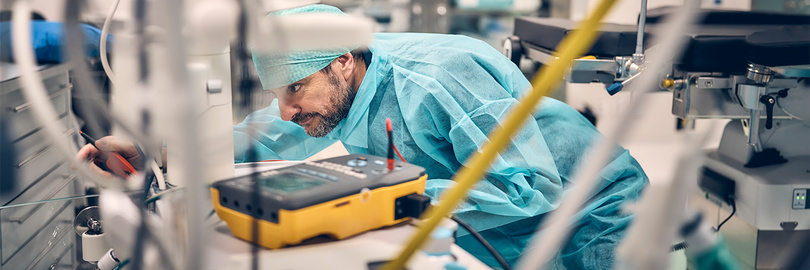
What are the benefits?
With the right maintenance strategy, failures can be prevented before they occur. A handful of good reasons for proactive maintenance.
Hospitals face the major challenge of ensuring maximum operational safety at all times – while working with largely unchanged equipment resources and steadily increasing demand. Failures of technical systems are not only a safety risk for patients. They disrupt operational workflows, can lead to high unplanned costs, and may negatively affect the efficiency and reputation of a hospital. Growing regulatory requirements also demand strict compliance, which can be jeopardized by technical failures.
Strategies and measures that ensure the operational readiness of medical devices as effectively as possible are therefore essential. But what are the key factors?
Addressing key challenges: Minimizing downtime and budget risks
Hospitals repeatedly report two central challenges. On the one hand, downtime represents the greatest operational weak point, affecting teams, planning, and patient throughput. On the other hand, there is budget uncertainty. Unplanned, reactive repairs caused by sudden failures result in unpredictable expenses. “Service contracts need to address both issues and provide solutions to minimize both downtime and budget risks,” says Duane Hawkins, Service Expert at Getinge. This helps identify faults at an early stage, improve the predictability of maintenance and repair needs to increase planning reliability, and reduce the scope of repairs – allowing hospitals to operate for as long as possible without equipment downtime.
Enhanced safety, cost-effectiveness & improved compliance
A comparative analysis from 2021 shows that a predominantly proactive maintenance strategy led to 52.7% fewer unplanned downtime events and 78.5% fewer failures compared to a predominantly reactive maintenance strategy [1].
Proactive maintenance and servicing options include both preventive maintenance, which is performed at defined intervals, and predictive maintenance, which goes one step further. Predictive maintenance makes it possible to identify potential problems at an early stage and predict when a failure is likely to occur – before it actually happens.
Unlike interval-based maintenance strategies, predictive maintenance relies on continuous real-time condition monitoring of equipment using intelligent technologies, as an example Getinge’s Fleetview solution. This allows wear to be detected early and helps minimize unplanned repairs and downtime. Among other benefits, this supports compliance with regulatory requirements for device safety.
In addition, the time between operational failures can be extended, maintenance intervals can be adjusted based on actual needs, and the service life of equipment can be maximized. Sustainable and targeted maintenance and spare parts planning helps reduce costs in the long term and optimize the efficiency of existing investments.
According to the comparative analysis, a predominantly predictive maintenance strategy results in 18.5% fewer unplanned downtime events and 87.3% fewer failures compared to preventive maintenance [1].
At a time of limited resources and increasing demands in daily clinical operations, predictive maintenance is therefore becoming increasingly important as a key factor for the safety, efficiency, and future viability of hospitals.
Conclusion: Maximizing uptime through proactive services
Proactive maintenance strategies reduce failures, maximize the operating time of medical devices, and can help hospitals save costs in the long term. Predictive maintenance is particularly efficient in this context – for example, when supported by an appropriate Getinge service contract.