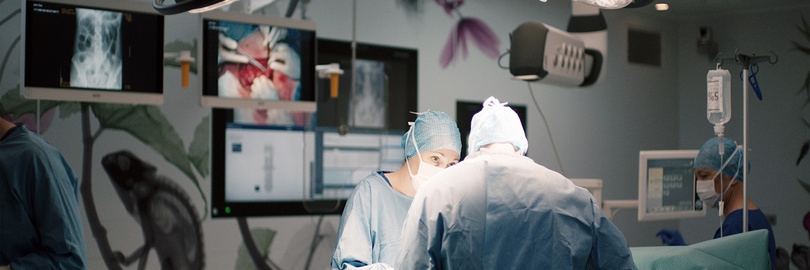
Today, numerous devices, systems, and data sources come together in the operating room – often without seamless connectivity. In daily clinical practice, this leads to fragmented workflows, manual intermediate steps, and increased coordination effort. Integrated OR systems address exactly this issue by bringing devices, data, and processes together within a unified structure. How this impacts everyday OR practice is outlined in the following article.
Isolated solutions reinforce fragmentation in the OR
The highly technologized operating room not only offers new possibilities but also introduces new challenges. An increasing number of medical devices, growing data volumes, and additional documentation requirements are adding complexity to daily OR workflows.
Many processes are still organized around individual devices – from setup before surgery to post-processing of data. At the same time, each technology uses its own interfaces or systems for data display. Information is distributed across different formats, and interoperability is lacking. As a result, it becomes increasingly difficult to maintain an overview and quickly access relevant data.
At the same time, manual steps – for example during device setup or data handling – require additional resources and make it harder to maintain full focus on the procedure. Integrated OR systems address this by bringing these isolated solutions together into a unified structure.
What are integrated OR systems?
Integrated OR systems (also referred to as OR integration or digital OR) are platforms that centrally connect devices, data, and imaging sources in the operating room and make them accessible via a shared user interface. The goal is centralized management and coordination of the OR infrastructure.
Modern systems combine video routing, communication, data management, and device control in a single interface, enabling more efficient use of the OR. Medical staff can conveniently operate the system via touch displays.
Integration also includes the ergonomic positioning of monitors and devices within the room, ensuring that relevant information is available within the direct field of view and that workflows are not interrupted by unnecessary movement or repositioning.
This shifts the perspective from individual devices to the overall workflow – from preparation to post-procedure.
More focus, less distraction
In a digital OR, all devices such as endoscopes, microscopes, or room cameras are integrated, and all data sources are consolidated on a main monitor. High-resolution imaging up to 4K UHD enables improved visualization during procedures and provides information on satellite monitors wherever it is needed.
Surgeons can call up predefined setups for different procedures and flexibly assign image and video sources to specific monitors. This allows the OR to be quickly adapted to different requirements while supporting ergonomic working conditions and continuous visibility of relevant information.
This is particularly relevant in endoscopy, where surgeons can operate without constant head movement. Environmental parameters such as temperature, lighting, and music can also be easily adjusted.
Another major advantage is the reduction of hazardous cables through standardized connections and centralized device integration. Fewer cables and devices contribute to a safer and more structured working environment and can reduce the risk of infections and work-related injuries.
Centralized control reduces the workload for OR staff and enables greater focus on the procedure and the patient.
Data and documentation within the same system
Integrated OR systems are connected to the hospital information system and use standards such as DICOM and HL7 to consolidate data from different sources and make it centrally available. Where time was previously spent searching for information, data can now be accessed quickly and easily – even outside the OR.
Documentation also changes: instead of resource-intensive manual data handling, patient data as well as image and video data are automatically stored in the digital OR and are audit-proof. The need for manual data entry is significantly reduced, lowering administrative workload and minimizing sources of error.
In addition, safety-related elements such as checklists can be integrated into the system and made available throughout the entire procedure.
Improved communication
Communication in the OR is no longer limited to the room itself. Integrated OR systems enable real-time transmission of image and video data and make them available for various use cases – such as coordination between ORs, interdisciplinary collaboration, or external consultations.
Live images from procedures can be transmitted to other areas of the hospital or external locations. At the same time, bidirectional connections enable direct communication between ORs or with external experts.
For the OR team, this means that information is available where it is needed and can be evaluated collaboratively – without additional steps or media disruptions. This supports faster coordination and improves collaboration in clinical practice.
From practice: What changes
Practical examples show that integrated OR systems can have a direct impact on workflows. After implementing an integrated system, hospitals reported a reduction in manual tasks and relief for staff in daily OR operations. Preparation and post-processing times were also reduced – in one case by up to 25%. At the same time, visibility within the OR improved, and centralized data management increased traceability and reduced risks in workflows.[1]
Another hospital reported that many individual operational tasks were eliminated in daily practice – such as cable management, handling multiple control devices, or moving between different stations in the OR. Patient data is now directly available in the system instead of being delayed. Administrative workload was also noticeably reduced – in practice, even eliminating routine overtime, allowing more time for patient care.[2]
Conclusion
Integrated OR systems do not just change individual aspects of the operating room but fundamentally transform how the OR functions as a system. Instead of a collection of individual devices and isolated solutions, a structured environment is created in which devices, data, and workflows are aligned.
This reduces friction in daily operations, improves transparency, and supports consistent workflows – from preparation to post-procedure. The OR is no longer defined by individual technologies but by the interaction within an integrated system.
One example of an integrated OR system is Tegris, which combines video routing, communication, data, and device management into a unified interface, enabling OR staff to centrally and easily control devices, data, and imaging sources.