Surgical skills develop through practice, feedback and continuous learning. But what role can on-demand video play in helping surgical teams build and retain their skills? Research highlights the potential of video-based learning, from self-paced practice to expert coaching.
Stronger suturing skills after 2 weeks
Video learners outperformed tutor-taught peers on 3 of 4 suture types, in a randomised trial of 50 medical students[1]
Expert coaching boosts surgical skill
Video-based coaching significantly improved performance in 10 of 15 randomised trials, across 382 surgical trainees[2]
As effective as in-person teaching
Video teaching matched conventional methods, across 11 studies and 715 surgical learners[3]
Knowledge and skill gains in most studies
14 of 22 studies showed statistically significant improvement, across 797 surgical learners[4]
How video-based learning improved surgical skill retention
A 2025 randomised trial at the University of Porto compared two ways of teaching basic surgical suturing[1]. Fifty medical students were randomly assigned to one of two groups. One group attended a 90-minute course with a surgeon as tutor. The other learned on their own from an instructional video, practising in a simulation room over one month, with no tutor and no feedback. They could pause and rewind the video as often as they liked.
Immediately after training, both groups performed equally well on 2 of the 4 sutures, and the video group scored higher on the other two. 2 weeks later, the video group scored significantly higher on 3 of the 4 sutures. Their total learning time was a median of 2 hours 15 minutes, about 45 minutes more than the in-person course, spread across the month.
The trial also showed trade-offs. The tutor-taught group completed sutures faster at both evaluations, and video learners rated their method as less viable, most likely because they missed direct feedback. And with 44 students analysed, all learning a basic skill, the results can’t be transferred directly to practising surgeons or complex procedures. But they point to something important: when learners can work through material at their own pace, the skill tends to stick.
Is video-based surgical education as effective as in-person teaching?
The Porto result fits a broader body of research. A 2022 systematic review and meta-analysis from the University of Sydney and Westmead Hospital[3], covering 11 studies and 715 participants, compared online video-based education with conventional teaching of basic surgical skills. Across the 380 participants included in its meta-analysis, it found no significant difference in skill proficiency between the two approaches, along with equivalent confidence and satisfaction.
In other words, video-based teaching performed as well as conventional teaching for basic surgical skills[3]. The review’s authors also point to convenience and accessibility as additional benefits of video-based education[3].
How video coaching with expert feedback improves surgical skills
Video becomes even more powerful when it’s paired with expert review. A 2025 meta-analysis from the RCSI University of Medicine and Health Sciences in Dublin[2] examined video-based coaching, where a coach reviews a recording of the trainee’s own performance and gives individual feedback. Across 15 randomised trials with 382 participants, surgical residents and medical students, coached trainees achieved significantly higher performance scores than those without coaching, and they improved more from where they started. By standard research measures, the effect was moderate to large. 10 of the 15 trials showed a statistically significant benefit. The effect held whether coaching took place in simulation or in live surgery, and whether trainees had one session or several.
That finding depends on more than simply having a recording. In every trial, coaching relied on trainees and experts being able to review the trainee’s own footage together[2]. For many surgical departments, the challenge is making the relevant recordings easy to find, share and discuss, and that is where surgical media management solutions can play a role.
Making surgical video accessible for lasting skill development
In practice, the evidence points to two ways surgical departments can put recorded procedures to work. The first is self-paced learning: clinicians working through relevant footage on their own schedule, pausing and replaying the moments that matter to them[1][4]. The second is structured review: a trainee and an experienced colleague discussing a recording of the trainee’s own procedure together[2]. Both depend on the same thing: the right recording being easy to find, play back and share.
This turns surgical media from stored files into a shared resource for continuous learning. A single recording can support a trainee’s preparation, a coaching session and a departmental case discussion. The authors of the meta-analysis call on training bodies to formally integrate video-based coaching into surgical training[2], and the King’s College review concludes that standardised video programmes are likely to enhance current teaching methods[4]. For surgical departments and hospital leadership, making recorded procedures accessible across the department is a practical step towards that.
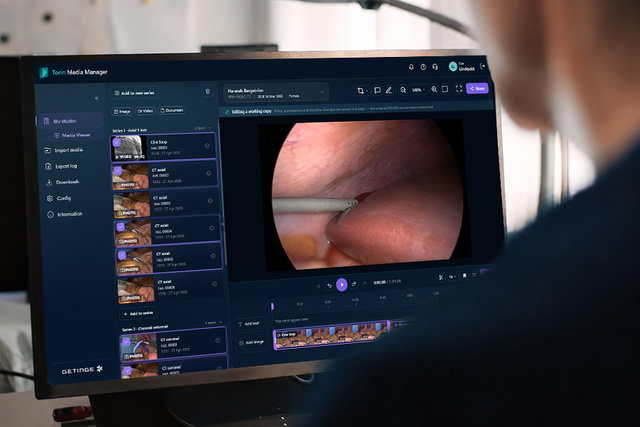
Torin Media Manager
Turn surgical media into continuous improvement
Every procedure generates surgical media that can strengthen consistency, precision and clinical insight over time. Torin Media Manager gives your department instant access to surgical recordings, images and documents, so that data becomes a resource for continuous learning.
It helps surgical teams to:
- Review surgical cases after procedures
- Capture, clip and share key moments
- Import and export media across systems