
Accurate surgical duration estimates are essential for reliable OR scheduling. Yet traditional planning often relies on procedure-level averages that don't reflect the complexity of individual cases. Research shows how machine learning can improve duration predictions, helping hospitals build more accurate surgical schedules and reduce disruptions throughout the day.
Why procedure-type averages break down across the surgical day
Surgical planning tools today estimate case duration based on procedure type, sometimes adjusted for surgeon or historical averages. Every other scheduling variable — theatre allocation, staffing, patient sequencing, downstream beds — is built on top of those estimates. When a duration estimate is off, everything downstream from it shifts. Across a full day of cases, that variance compounds, and by mid-morning the schedule is already being renegotiated.
The gap is not in the estimates themselves — procedure-level averages are a reasonable baseline. The gap is in what they leave out. Actual case duration is shaped by a much wider set of factors: patient physiology, comorbidity profile, anaesthesia approach, specific surgeon, case complexity. These vary from patient to patient, and current scheduling tools were not built to account for them. The result is a plan built on generalised assumptions applied to individual cases — where the variance is predictable in the data, but invisible in the schedule.
How case-level machine learning improves surgical duration prediction
Researchers at IE University in Madrid studied whether machine-learning models could improve on experience-based surgery duration estimates [1]. Using a dataset of over 77,000 surgeries spanning multiple specialties, they developed models that drew on the full range of case-level variables — patient characteristics, procedure details, surgeon experience, surgical team composition — rather than relying on procedure-type averages. The models were then compared directly against estimates that mimic the current decision-maker’s approach.
The result: data-driven prediction improved duration estimation accuracy by 24% (mean absolute error). In practical terms, that means the gap between what the schedule expects and what actually happens in the theatre narrows meaningfully. Fewer cases overrun their allocated slots. Fewer downstream cases are displaced. The knock-on effects that turn a manageable day into an overtime day become less frequent — not because the cases change, but because the plan starts from more accurate assumptions.
Importantly, the data needed for this level of prediction is not new. It is the same patient, procedure, and clinical information that hospitals already capture during booking and pre-assessment. The improvement comes from using that data at a resolution and scale that conventional estimation methods were not designed for.
What better duration estimates enable in the scheduling process
More accurate duration prediction is valuable on its own. But its full impact emerges when it feeds into how the surgical day is assembled. A 2025 study from the University of Minho’s ALGORITMI Research Centre, conducted in collaboration with one of Portugal’s leading university hospitals, tested exactly this [2]. The researchers applied a heuristic optimization algorithm to surgical scheduling, using improved duration estimates as inputs. The result: 96.7% of surgeries were successfully scheduled within their target deadline windows.
That figure reflects what becomes possible when the scheduling process works with realistic, case-specific time expectations rather than standardised procedure slots. Cases are sequenced based on their predicted duration. Gaps and overlaps that would otherwise surface mid-day are identified at the planning stage. The schedule becomes a closer representation of the day ahead — which means fewer intraday adjustments, fewer delays, and less pressure on the team to absorb variance through workarounds.
96.7%
of surgeries scheduled within their target deadline windows [2]
In a scheduling optimization study involving 429 surgeries, researchers demonstrated how an algorithm-based approach could support surgical scheduling.
Bringing case-level duration prediction into the surgical booking flow
For this to work in practice, case-level duration prediction needs to sit inside the surgical booking flow — not as a standalone report or a retrospective analysis, but as a live input at the point where the schedule is being built. When a case is booked, the system draws on the patient’s specific profile to generate a duration estimate. When the full day’s list is assembled, the scheduling logic accounts for those estimates alongside theatre availability, staffing, and downstream capacity.
The integration point matters. Duration prediction that arrives after the schedule is locked is too late to shape the plan. Duration prediction that is available at booking — drawn from the same data the pre-assessment process already captures — becomes one of the core variables the schedule is built around. The planning tool gains a level of precision it did not previously have, without requiring new data collection or additional workflow steps.
What more accurate duration estimates change in daily surgical practice
No prediction model will eliminate surgical variability. Unexpected findings, complications, and clinical decisions will always introduce variance that no algorithm can foresee. But there is a meaningful difference between a schedule built on procedure-type averages and one built on case-specific predictions drawn from the hospital’s own data. The first absorbs variance reactively, through workarounds and overtime. The second anticipates it, by building a plan that is closer to the day that will actually unfold.
The evidence shows that case-level duration prediction improves estimation accuracy by 24%, and that when those predictions feed into scheduling optimization, the vast majority of cases can be planned within their target windows. For perioperative and hospital leadership, the opportunity is to make duration estimation a dynamic, patient-specific input in the surgical booking flow — and in doing so, build a schedule that starts the day closer to where it will finish.
Torin Plan Optimizer
Anticipating needs to keep surgical care on track
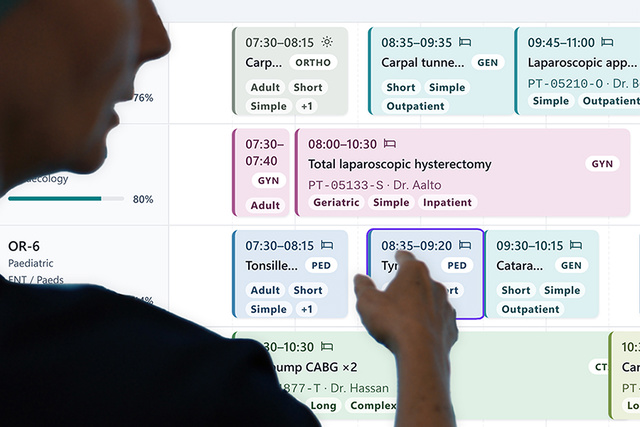
Balance complex surgical workflows with greater clarity and control, even when resources are constrained. Torin Plan Optimizer uses AI to predict surgical duration and post-operative needs, aligning OR schedules with surgeon and staff availability, room capacity, and ICU and ward resources.
AI proposes. You decide.