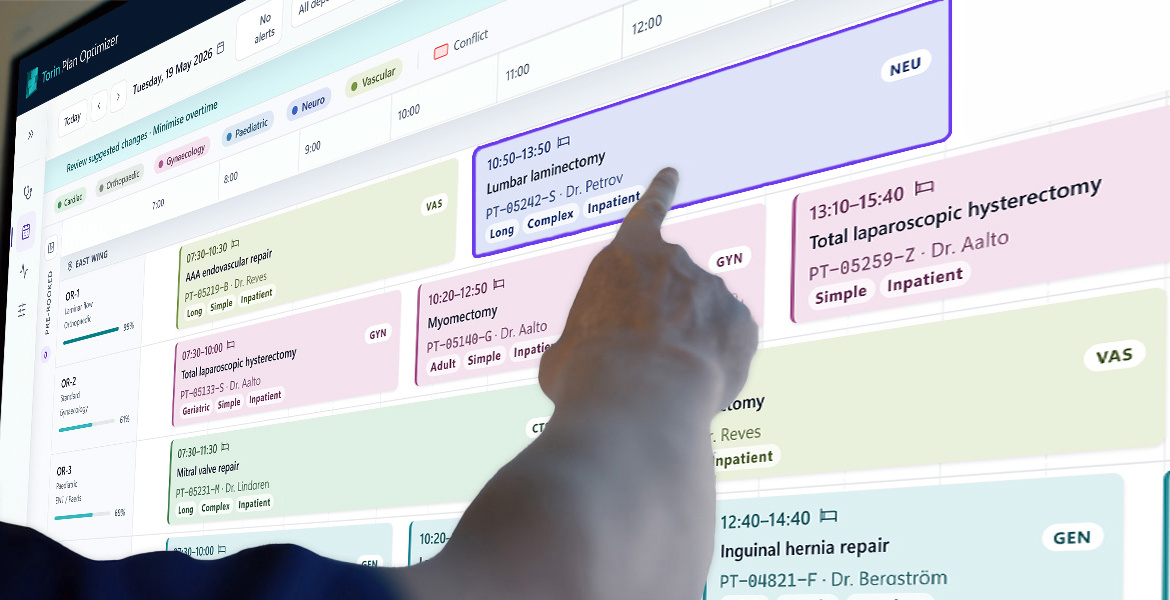
Surgical schedules depend on more than operating room availability. Case duration, staffing, equipment and post-operative capacity all influence how the day unfolds. When these factors are planned separately, delays and last-minute changes become harder to avoid. Research shows how dynamic surgical scheduling can bring these dependencies together to support more reliable OR planning.
The evidence for planning the surgical day as one system
How dynamic scheduling cut rescheduling from 15% to 5%
Three German hospitals recently tested a different approach to surgical scheduling, covering 1,497 elective procedures over six months[1]. Instead of optimising individual parts of the OR workflow in isolation, they implemented a framework that combined dynamic scheduling with predictive analytics[1]. The planning approach accounted for multiple variables simultaneously: case duration, resource dependencies, downstream capacity, and historical patterns from the hospital’s own data.
The outcome: surgical rescheduling rates dropped from 15% to 5%. Elective surgery delays were reduced by 67%[1]. These findings come from a 2025 study conducted by researchers at Comenius University Bratislava and published in the peer-reviewed journal Medicni Perspektivi[1]. The scale of the improvement raised a question worth examining: why did treating scheduling variables as interdependent produce results that years of step-by-step optimisation had not?
Why optimizing variables in isolation plateaus?
Most hospitals have invested in improving their surgical workflow. Turnover-time initiatives, Lean programmes, standardised checklists, better communication protocols. These deliver gains. But in many hospitals, rescheduling rates and delay frequencies have reached a ceiling. The same approaches that moved the needle a decade ago are now producing diminishing returns.
A 2024 systematic review published in the World Journal of Surgery examined this pattern[2]. Drawing on 38 studies spanning four decades, the review looked at why turnover time, one of the most commonly targeted metrics in OR efficiency, has proven so difficult to improve on a sustained basis[2]. It found that the most effective solutions were not single fixes, but bundles of changes designed around how the whole clinical work system operates[2]. The implication extends beyond turnover time: improving one metric in isolation does little when the variables it depends on remain uncoordinated. The same logic applies to start-time compliance, cancellation rates, and other commonly isolated metrics.
The limitation is not in how well individual variables are managed. It is in the fact that they are managed independently. A surgical day is shaped by the interaction between case duration, staffing, equipment, bed availability, and patient flow[1]. When planning tools treat these as separate inputs, optimised one at a time, the schedule cannot account for how they affect each other.
Why isolated fixes stall?
5 interacting variables
Case duration, staffing, equipment, bed availability and patient flow shape the surgical day together. When planning tools optimise them one at a time, the schedule can’t account for how they affect each other[1]
How dynamic scheduling coordinates variables across the surgical day?
Dynamic scheduling starts from a different premise. Rather than optimising individual variables and hoping the overall schedule holds, it treats all scheduling variables as interconnected. The planning approach works with the actual booked surgical data and optimises based on all available variables together: predicted case duration, staffing requirements, equipment dependencies, downstream bed capacity. It further incorporates historical data from the hospital’s own records to improve the accuracy of those predictions over time[1].
The result is a schedule where the variables work in harmony rather than in isolation. When a complex case is booked on a day with constrained ICU capacity, the planning approach recognises that interaction and adjusts the plan accordingly[1]. When historical data shows that a particular combination of cases consistently leads to overruns, the plan accounts for that pattern before the day begins. Conflicts that would otherwise surface mid-day become visible at the point of planning.
This is the shift the German hospitals made[1]. They did not ask their teams to execute the existing plan more efficiently. They changed how the plan itself was built. The day was assembled based on how variables interact, not on how each performs in isolation. That difference accounts for the scale of the improvement.
Bringing the right surgical planning inputs together
A coordinated planning approach depends on two categories of data coming together at the moment the schedule is built. The first is the information generated at the point of booking: patient characteristics, procedure type, surgeon, comorbidities, resource requirements. This is the data that shapes each individual case’s predicted duration, complexity, and post-operative destination. The second is historical data: patterns of actual duration versus estimated duration, overrun frequencies for specific case types, seasonal variations in bed availability, and outcomes from similar scheduling configurations[1]. Together, these inputs allow the planning team to work with both an optimised individual case plan and an optimised overall schedule for the day.
The important point is that most hospitals already capture this data across their existing systems[1]. The shift is not in collecting new information. It is in connecting existing data to the scheduling decision at the moment the plan is being built, so the planning team can work with the best possible view of the day based on everything the hospital already knows.
The gap is in connecting data to the schedule
Untapped data
The shift isn’t about collecting new information. Much of the data scheduling needs is often already in existing hospital systems[1]
The full picture at planning
Linking that data to scheduling decisions as the plan is built gives the team the best possible view of the day, based on everything the hospital already knows[1]
From managing the day to planning it
No scheduling approach will eliminate variability in the surgical day. Clinical unpredictability is inherent. But the German data demonstrates what changes when the scheduling approach shifts from managing disruption as it occurs to anticipating it at the point of planning[1]. Rescheduling cut by two-thirds. Delays cut by two-thirds[1]. Not from working harder within the existing framework, but from building a fundamentally better plan.
Further improvements in surgical scheduling may come not only from optimising individual variables, but from better coordinating how they work together. Dynamic scheduling brings together case-level predictions, resource availability and historical data to account for dependencies before the surgical day begins. For hospital and perioperative leadership, the opportunity is to move from reacting to disruptions to planning ahead.
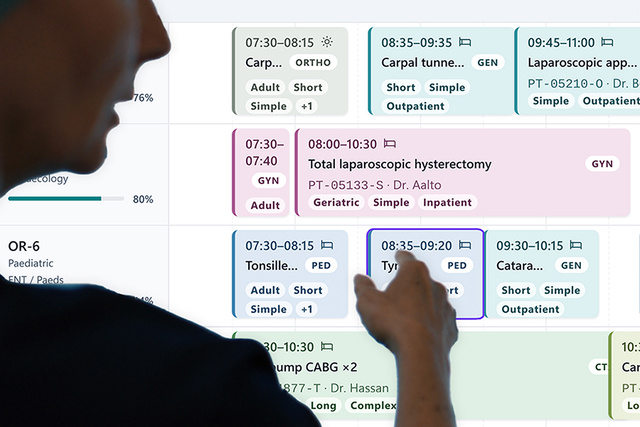
Torin Plan Optimizer
Anticipating needs to keep surgical care on track
Balance complex surgical workflows with greater clarity and control, even when resources are constrained. Torin Plan Optimizer uses AI to predict surgical duration and post-operative needs, aligning OR schedules with surgeon and staff availability, room capacity, and ICU and ward resources.
AI proposes. You decide.