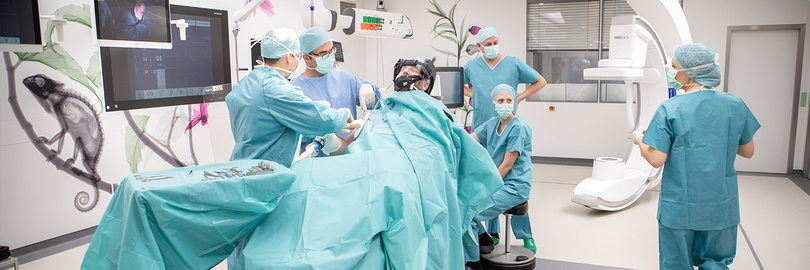
Fatigue, musculoskeletal strain, and workflow disruptions remain common realities in the operating room. While these issues are often discussed in relation to individual devices, their root causes usually lie elsewhere: in how the operating room is configured as a working environment.
Surgical teams operate in a space where positioning systems, lighting, imaging, digital interfaces, and equipment setups must function together under time pressure. When this environment does not work together, staff compensate through additional movement, manual adjustments, and constant reorientation. Over time, this affects both physical endurance and procedural stability.
Ergonomics in the OR therefore depends less on individual components than on whether the environment is designed to support clinical workflows as a whole.
Physical load often results from layout decisions, not workload
Prolonged standing, reaching, and repositioning are part of surgical practice. What increases strain is when teams must repeatedly adapt to the room rather than the room supporting the procedure.
Limited adjustability of positioning systems, poorly accessible supply units, or equipment that interrupts movement paths can turn routine steps into repeated micro-corrections. These interruptions rarely appear in workflow plans but accumulate over the duration of a procedure.
Operating rooms designed around procedural flow reduce this effect. When positioning, access points, and equipment placement follow the logic of the intervention, physical effort decreases and coordination becomes more predictable.
Visual conditions influence posture and concentration
Lighting in the OR is often evaluated in terms of brightness and coverage. Equally relevant is how lighting supports visual stability over time. Strong contrast between the surgical field and surrounding areas forces the eyes to constantly adapt. This contributes to fatigue and often leads to compensatory posture changes during longer procedures.
Balanced illumination that considers the entire visual field helps maintain stable perception and reduces this secondary strain. In practice, visual ergonomics directly influences how long teams can maintain precise and controlled work.
Digital fragmentation creates invisible workload
As digital technologies expand in the OR, the number of interfaces, displays, and data sources continues to grow. When these systems operate independently, staff must coordinate them manually.
Searching for imaging data, adjusting devices across multiple control panels, or managing video routing during a procedure introduces interruptions that are rarely accounted for in time planning. These tasks consume attention and increase the likelihood of delays or errors.
Environments that centralize control and data access reduce this hidden workload. They allow teams to maintain procedural focus rather than shifting attention to system management.
Ergonomics reveals how well the OR functions as a working environment
Ergonomic performance in the operating room is not primarily a product feature. It is the outcome of how positioning, lighting, equipment layout, and digital infrastructure are aligned with clinical workflow. Where these elements support each other, teams can experience fewer interruptions, reduced physical strain. Where they do not, staff bridge the gaps themselves.
For hospitals planning OR upgrades or new installations, ergonomics therefore provides a useful indicator: it shows whether the room has been designed around individual technologies or around the realities of surgical work. Achieving this requires not only selecting the right components, but working with partners who understand how surgical workflow, infrastructure, and technology interact in daily practice.