From mobile robots to connected sterile supply logistics
Why automation is becoming a strategic priority in CSSD
Central Sterile Services Departments are facing growing operational challenges that are increasingly difficult to manage through manual processes alone. Instrument inventories are expanding, set configurations are becoming more complex, and regulatory expectations around documentation, traceability, and process control continue to rise. At the same time, CSSDs across regions report persistent workforce shortages and growing cost pressure. As a result, CSSD leaders are looking for new ways to organize work, manage risks, and deploy resources more efficiently.
Automation is an emerging strategic response to this growing operational complexity. Hospitals are moving beyond isolated transport tasks by connecting autonomous transport, intelligent software orchestration, and standardized workflows in one coordinated system to address workforce constraints, improve operational efficiency, reduce variability, and increase workflow transparency.
This integrated approach is increasingly reflected in automation platforms such as Getinge Automatiq, which combine these technologies to support coordinated sterile supply workflows.
Autonomous Mobile Robots in CSSD: from fixed routes to adaptive logistics
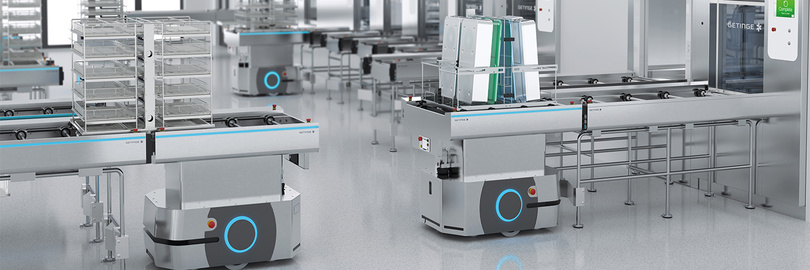
Autonomous Mobile Robots (AMRs) are one of the key technologies enabling integrated CSSD automation. Unlike traditional Automated Guided Vehicles (AGVs), which typically rely on predefined guidance or routes, AMRs use sensors and digital maps to navigate dynamically and adapt their path to changing conditions. They can detect obstacles, interact with doors, elevators, and transfer stations, and reroute when required, enabling automated transportation through complex hospital environments.
AMRs are not intended to replace sterile processing work. Instead, they take over repetitive and physically demanding tasks. Typical applications include:
- transport of washer racks and carts from soiled intake to washer-disinfectors,
- movement of clean loads to inspection and packing stations,
- intermediate buffering between process steps,
- redistribution of carts based on real-time priorities,
- return of empty carts to defined staging areas,
- transport of processed loads toward sterile storage zones.
Intermediate buffering is a good example. “Instead of strictly following a first-in-first-out logic, AMRs enable dynamic re-sequencing of loads based on urgency, or OR demand,” explains Jonas Magnusson, Director Automation & Infection Control Workflow at Getinge. This allows CSSDs to absorb variability without manual intervention.
Implementing automation in CSSDs
Successful automation projects begin long before the first robot arrives. CSSDs that achieve measurable benefits start with process analysis rather than technology selection. “Automation only creates value when it addresses a clearly defined operational task,” notes Jonas Magnusson. “Otherwise, it risks delivering limited return and low acceptance within the team.”
Technology should support clearly defined operational objectives. Successful automation initiatives begin with understanding workflows, identifying bottlenecks, and determining where automation can create meaningful operational value.
Key questions include:
- Where do delays and bottlenecks occur today?
- Which tasks create the highest physical strain?
- How many different carts, trays, and containers are in use?
- Can transport units be standardized?
Simulation tools can be used early in planning to evaluate throughput assumptions, estimate the required number of robots, and assess layout decisions before implementation. By modelling different workflow scenarios before deployment, hospitals can make more informed decisions, optimize resource allocation, and reduce implementation risks.
One practical consideration is the variety of load carriers. Different sizes, weights, and formats often need to be harmonized or supported through adapters. Addressing these differences alone can drive significant process improvements. Standardization of load carriers can therefore be an important enabler of Automation.
Existing infrastructure, workflow maturity, and operational priorities all influence how and when automation is introduced. AMRs can also be integrated with existing automation technologies, including shuttle systems, loaders, and fixed conveyor solutions. In many projects, they complement existing infrastructure, allowing hospitals to preserve existing investments while expanding automation capabilities step by step.
Existing departments can introduce automation incrementally – for example by starting in the soiled area, focusing on long transport routes, or supporting peak workload periods. A hybrid approach, where manual fallback options remain available, can reduce implementation risk, supports staff acceptance, and allows automation to be introduced step by step. Rather than being a one-time project, automation can be expanded in phases as operational requirements evolve.
Software orchestration: connecting the automation workflow
Every automation project is at least as much a software project as a hardware project. In an integrated automation setup, software becomes the orchestration layer that connects robots, washers, sterilizers, loaders, and buffer stations into one coordinated workflow. This enables requests to be coordinated, tasks to be prioritized, equipment availability to be synchronized, and real-time visibility to be provided across the sterile processing workflow. This software layer:
- assigns transport tasks dynamically,
- prioritizes loads based on deadlines and clinical demand,
- prevents equipment blockages,
- synchronizes robots, washers, sterilizers, and buffers,
- interfaces with data management systems such as T-DOC.
In highly automated CSSDs, software increasingly manages what human coordination can no longer reliably oversee. “If a washer is finished and the cart is not removed, the machine is blocked. This is something software can help manage very effectively, but it is difficult to coordinate with manual processes,” says Jonas Magnusson.
The operational impact of automation
Automation can support improvements in areas such as coordination, workflow consistency and workload distribution. Potential benefits include fewer manual transport steps, more predictable sequencing between process stages, reduced equipment idle time caused by delayed material movement, and lower physical handling demands for staff.
These benefits result from the interaction of transport automation, intelligent software orchestration, standardized workflows, and clearly defined operational objectives. Ultimately, resilient and efficient sterile processing operations depend on how effectively people, processes, and software work together – not on individual technologies alone.
Reliable sterile supply logistics also has a direct operational link to surgical readiness: when instruments move predictably through cleaning, inspection, sterilization, and storage, teams are better equipped to support planned surgical activity.
From automation strategies to practical implementation
At Getinge, we support hospitals with connected automation solutions designed to streamline sterile reprocessing workflows. With Getinge Automatiq, autonomous mobile robots, automated loaders and unloaders, buffer stations and Automatiq Hub software can work together to coordinate material flow across the CSSD. This approach supports safer, more reliable and more consistent sterile reprocessing – adapted to each hospital's infrastructure, workflow maturity and operational priorities.