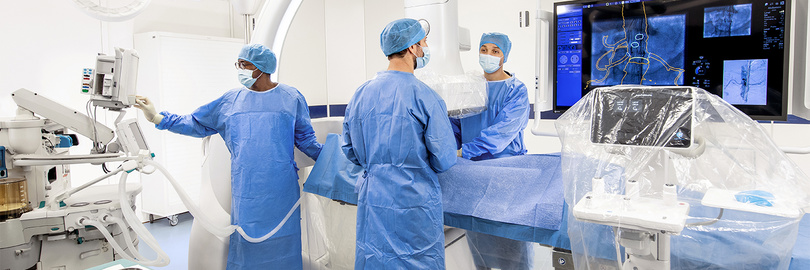
How coordinated operating room environments support sustainable value over time
Hospitals around the world have invested heavily in advanced surgical technologies over the past decades. Devices perform reliably, digital capabilities continue to expand, and clinical expertise remains high. The expectation is clear: these investments shall create long-term value – through stable operations, efficient use of resources, and the ability to adapt to future requirements.
In reality, this is not always the case. Many hospitals still deal with operational instability in the operating room (OR), underused capacity, and growing constraints when adapting existing environments. These issues rarely come down to a single device or a clear technical failure. They become visible in day-to-day operation – especially in highly specialized settings where procedures cannot simply be moved. As more technologies are added and workflows evolve, coordination becomes a decisive factor. Individual systems may work as intended, but long-term value depends on how reliably the entire OR environment works together in daily use.
Operational stability as the foundation of long-term value
Surgical schedules depend on multiple systems being available and ready at the same time. Even small disruptions can affect the entire day, from staff coordination and room utilization to patient flow. In specialized operating rooms, this becomes visible very quickly as even minor limitations can have immediate consequences. If a hybrid OR is not fully ready, procedures cannot simply be relocated. Rooms being unavailable, setups needing to be rebuilt, or last-minute adjustments don’t just affect one case, they often shift the entire schedule.
These situations are typical in environments that have grown over time. Technologies, maintenance processes, and infrastructure have been introduced step by step and often without a shared operational logic across the room. The result: variability. The opposite happens where systems are aligned: processes run as expected, and the day becomes more predictable.
Usable capacity depends on how work actually gets done
OR capacity is often understood as the number of rooms or available surgical time. In practice, it depends on how reliably procedures can be prepared and performed.
In many environments, teams compensate for structural limitations. Equipment is repositioned, setups are manually adjusted between cases, information is pulled together from different sources. These steps are part of the routine, but they cost time – especially during preparation and turnover. As a result, part of the available capacity remains unused. Schedules become sensitive to delays, and throughput varies from day to day – even though the equipment itself is fully functional.
When systems are coordinated, fewer manual adjustments are needed. Setups are more consistent, preparation becomes more predictable, and planned capacity is more likely to be realized in practice.
Adaptability as protection of long-term investment
Operating rooms are long-term infrastructure assets expected to support clinical work for decades.
During that time, new technologies are introduced, integration requirements increase, and clinical needs change.
Many environments are not designed for this level of change. Rooms initially planned for a specific setup must later accommodate additional technologies, larger devices, or new integration needs,
often leading to spatial constraints and workarounds in daily use. This adds effort and makes even small changes harder to implement.
Environments that allow gradual adaptation handle this differently. Systems can be replaced or expanded without disrupting workflows. This keeps the room usable over time and helps avoid repeated structural changes.
From individual solutions to coordinated environments
Most ORs are the result of many individual decisions over time. Each investment solves a specific need, but the overall environment is rarely developed as a coordinated system.
These decisions are often made under time pressure – for example when rooms are unavailable or require urgent updates. In such situations, existing concepts are frequently replicated. This saves time in the moment, but it also carries forward existing limitations.
A coordinated environment starts from a different point. It looks at how workflows, equipment, digital systems, and service processes interact – and how these interactions will evolve over time.
This reduces friction in daily work and makes it easier to handle changes later on.
The OR as a strategic infrastructure asset
Clinical excellence remains the foundation of surgical care. Maintaining it over time depends on how well the operating environment supports daily work. If processes are unstable, performance becomes unpredictable. If capacity cannot be fully used, resources are lost. If adaptation becomes difficult, investments lose value faster than expected. For this reason, the OR should be seen not only as a clinical space, but as a strategic infrastructure asset – one whose long-term value depends on how well systems, workflows, and services function together in practice.
This is where partners such as Getinge come into play – bringing together equipment, digital solutions, and service concepts with a system-level understanding of the operating room and its long-term requirements.