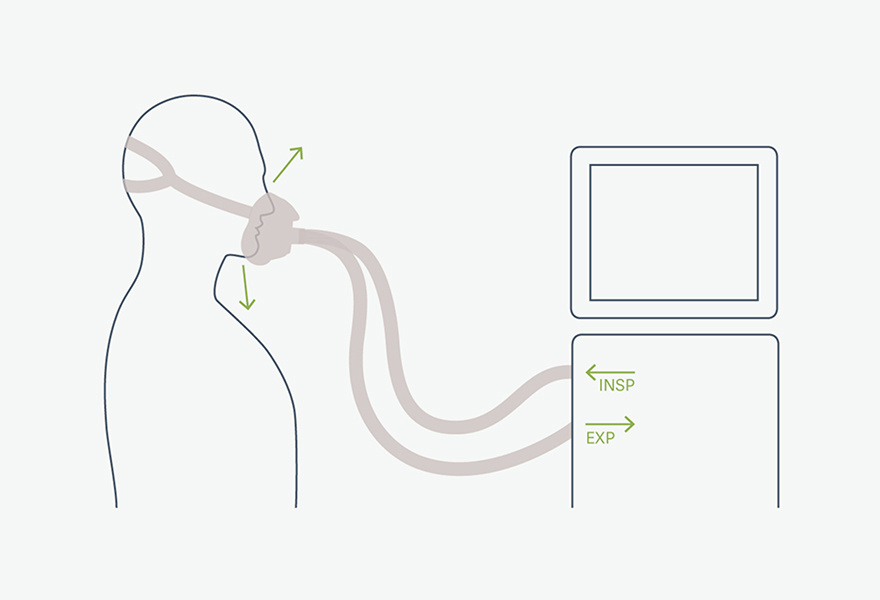
Non-invasive ventilation (NIV) can be delivered using different types of ventilators. Although the therapeutic goal is the same — the devices differ in how they manage leaks, deliver pressure, and interact with the patient. Understanding these differences is important to ensure optimal patient treatment.
When ventilators are used for non-invasive ventilation (NIV), performance is influenced by how they handle leaks, how quickly they respond to patient effort, and how well they stay synchronized with the patient’s breathing [1].
Leaks are a central challenge in NIV. They can interfere with triggering, pressurization, and cycling, and may lead to false triggers, failed triggers, delayed triggering, or late cycling [1]. These effects become more pronounced as leaks increase and can result in suboptimal patient–ventilator interaction [2],[3]. Importantly, leaks during NIV are dynamic and may change with breathing phase, interface position, or patient condition [2].
Whilst early NIV devices had important limitations, including limited or no leak compensation, lack of internal oxygen blenders, and restricted monitoring capabilities, modern devices have significantly improved. Critical care ventilators were originally invasive devices and performed poorly for NIV until newer generations introduced leak-compensation modes. As a result, the boundaries between ventilator categories have become less distinct. [1].
Three types of ventilators used for NIV
NIV can be delivered using several ventilator technologies, which are generally classified into three main categories:
- Bi-level ventilators
- Critical care ventilators
- Intermediate ventilators
These categories mainly reflect shared technical characteristics, particularly the configuration of the breathing circuit [1].
Bi-level ventilators: built to work with leaks
Bi-level ventilators are designed for non-invasive ventilation in the presence of leaks. They use a single-limbed circuit, meaning inhaled and exhaled gases share the same pathway. Exhaled air is cleared through a leak port in the circuit or mask interface, which helps remove carbon dioxide and reduce rebreathing [1]. If the patient’s minute volume exceeds the capacity of this leak flow, carbon dioxide can accumulate. This risk can be reduced by adjusting expiratory pressure, using appropriate exhalation valves, or positioning the leak port in the mask [1].
Modern devices can differentiate between intentional and unintentional leaks and adjust flow accordingly. Because there is no separate exhalation limb, interfaces require anti-asphyxiation valves in case of device failure [1]. While these systems are designed to tolerate leaks, excessive leaks can impair performance, for example by causing trigger or cycling asynchrony [1].
Current bi-level ventilators offer multiple modes, monitoring, alarms, and oxygen blending. Tidal volume and leak are estimated using device-specific algorithms, although their accuracy has not been well studied [1]. Some devices also support intra-hospital transport and, in certain cases, can be used with invasive airways [1].
Typical features at a glance
- Single-limb circuit with leak port
- Designed for operation in the presence of leaks
- Interface-based leak compensation
- Anti-asphyxiation valve requirement
- Monitoring, alarms, and oxygen blending
- Algorithm-based estimation of tidal volume and leak
- Battery options for transport
- Possible use with invasive airways in selected cases
Critical care ventilators: adapted for NIV
Critical care ventilators were originally designed to deliver invasive positive pressure ventilation. They use a dual-limbed circuit, meaning with separate inspiratory and expiratory limbs. The presence of an expiratory limb and valve reduces the risk of rebreathing exhaled gases [1].
Historically, these ventilators had limitations in providing NIV. Newer generations now include dedicated NIV modes that enable automatic leak compensation. These modes are not fundamentally different in principle but are adapted to function in the presence of leaks [1]. They can also deactivate certain alarm parameters that would otherwise be unnecessary or interfere with NIV use [1].
Because of their active expiratory valve, critical care ventilators do not require an anti-asphyxiation valve in the interface. Instead, correct alarm configuration is required to ensure that device malfunctions are detected [1].
Typical features at a glance
- Dual-limb circuit with inspiratory and expiratory limbs
- Active expiratory valve reducing risk of rebreathing
- Dedicated NIV modes with leak compensation
- Adjustable alarm settings for NIV use
- No need for anti-asphyxiation valve in the interface [1]
Intermediate ventilators: flexible across care settings
Intermediate ventilators are positioned between dedicated NIV ventilators and ICU ventilators. They are commonly used in transport settings, emergency departments, step-down units, and home ventilation. These devices are often turbine-driven, portable, and battery powered.
Intermediate ventilators may use single-limb or dual-limb circuits. In single-limb systems, exhalation occurs either through an active exhalation valve near the patient or via a passive leak port similar to those used in bi-level ventilators [1].
Modern devices support both pressure- and volume-targeted ventilation modes. Some also provide adaptive ventilation modes such as average volume-assured pressure support (AVAPS), intelligent volume-assured pressure support (iVAPS) [1] or non-invasive volume support (NIV VS).
Typical features at a glance
- Use in transport and home settings
- Single- or dual-limb circuit configurations
- Exhalation via active valve or passive leak (single-limb)
- Pressure- and volume-targeted ventilation modes
- Availability of advanced modes such as AVAPS, iVAPS [1], and NIV VS.